Monday, April 28, 2008

Auction News: Sotheby’s Geneva Evening Sale of Important Watches

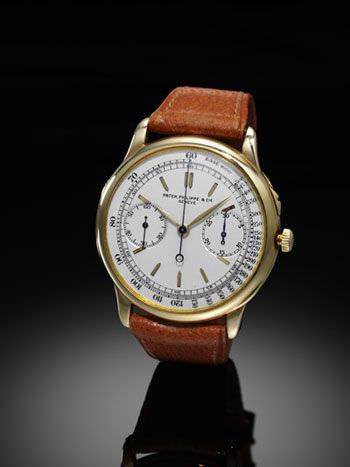
Sotheby’s Geneva Evening Sale will offer Important Watches at Auction on Sunday, May 11th, 2008. Comprising around 200 lots, the sale is highlighted by an important and possibly unique over-sized single button chronograph wristwatch created by Patek Philippe in 1932. Formerly the property of Count Carlo Felice Trossi, this piece is estimated to sell over $2 million.


The “Trossi Legenda” Patek Philippe

Measuring 46 millimeters in diameter, this chronograph is most probably unique and is one of the largest wristwatches ever made by the company. It was clearly specially chosen by Count Trossi as a practical timekeeper for use in motor racing and aviation to assist with the accurate timing of events in a highly visible format. In later years, aviators’ wristwatches were typically large in size and very few were made by Patek Philippe. Only one other wristwatch of similar size by Patek Philippe has appeared on the auction market and that was manufactured some 20 years later with a substantially smaller movement. Count Carlo Felice Trossiwas was born into an aristocratic Italian family 100 years ago on 27th April 1908. Captivated by the possibilities of speed, Count Trossi was a motor car and speed boat racer as well as an early pioneer of flight. In 1932 he became the President of Ferrari Scuderia. The highlights of Trossi’s motoring career culminated in his wins at the Italian and Swiss Grand Prix respectively in the years 1947 and 1948.

Another highlight in the sale is an extremely rare and fine over-sized stainless steel chronograph Patek Philippe wristwatch with register, no.862323, Ref. 530A, dated 1939. Among the four wristwatches with reference 530A known to have been made by Patek Philippe, the example included in the sale is the only one featuring this particular dial. From a private collector, this piece is estimated at CHF700,000-900,000 ($635,000-815,000 ).

Info via Sotheby's and Europastar.

Horology News: Richemont: Unaudited Sales Figures for the financial year ended 31 March 2008

Some interesting Richemont sales figures data for this past year just released. What we can easily see is almost double digit sales across the whole group areas of business, but especially in the specialty watchmaking groups noted highest sales growth by IWC and Jaeger LeCoultre. Farther geographical breakdown shows the anticipated highest growth in the Asia-Pacific region of 31% (headed by China and Hong Kong) with suspected low teens percentage growth in both Europe and Americas. Interesting how Europe still counts for almost 43% of the total group sales as compared to quarter of Asia-Pacific and one fifth of Americas. Another clue is that Middle East and I assume Russia as well are counted as Europe group sales so it would be very interesting to see a further country breakdowns. Sadly there were no individual brand sales breakdowns for further analysis.

Sunday, April 27, 2008

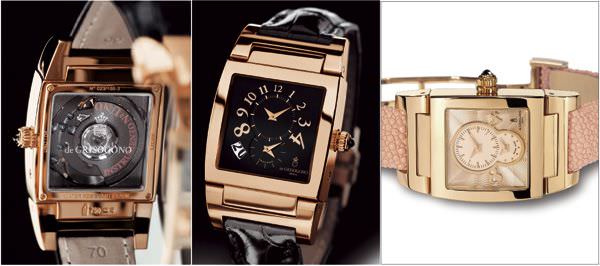
Brand Overview: de Grisogono "say what?"

de Grisogono .... say what?

History

Who would have when I would have ever talked about watch news from de Grisogono or any other mainly jewelry/fashion oriented brand. This year marks de Grisogono 15th anniversary and the 8th year since it introduced its first watch. They have much to celebrate having accomplished a remarkable amount in its fairly brief history. Founded in 1993 as a Geneva boutique based jewelry maker lauded early for its inventive high-end jewelry pieces and the untraditional use of gemstones. The brands commander and designer in chief, unrestrained and always bold Fawaz Gruosi, is the one always deservedly credited for the continuing growth and success of this brand. Although he never obtained any formal design or horology schooling Gruosi knows and does what he likes and so far it has proven to be a winning strategy. From his love affair with dark gemstones (today he is credited with popularizing black diamonds which are sort of a signature of the brand), to icy white diamonds collection (paired up in combination with pearls and gems), galuchat (highly texture stingray skin), to grey and brown gold and diamonds. You could say anything unusual has crossed it doors and became wildly popular with de Grisogono customers.


In 2000 finally the watches got their turn and Gruosi didn't fail to disappoint. Under the guide of his own preferences for functions Gruosi designed the Instrumento No. Uno which was a bonafied hit and still is the best seller of this young brand. Among the dual functions, large geometric case with mobile lugs, a very distinctive styling and finally the signature touch of a black diamond set in the crown. Followed were annual intros of models comprising of men's and women's various limited and non-limited as well as dress and sport versions. As demand has grown so has their manufacturing but at a measured pace. Operating from the recently expanded Plans-les-Quates workshop they produced approximately 4,000 watches in 2007 and may expand in future up to a self imposed cap of 10,000 watches. As well keeping their distribution exclusive and retail in check, their goal it to establish up to 20 boutiques worldwide.

All this leading up to BaselWorld 2008 with excited rumors of a revolutionary new models including a new movement that would change the way de Grisogono was perceived in the eyes of many horology aficionados. After having a chance to view the new models all I can say is that they certainly succeeded at that.

Otturatore

De Grisogono defied the fundamentals of watchmaking with the launching of its Otturatore, a timepiece combining audacity, refinement and modernism. Aptly named
9Otturatore means shutter) recalling the function of the photo cameras with goood reason as its mobile dial features a sequential display of seconds, date, moon phases and power reserve, with 3 of them always concealed.


By a simple manipulation, the sequential mechanism of the Otturatore can be displaced by 90°, simplifying the display of multiple subdials and indicators which tend to clutter a dial by revealing only one at a time, of course at its owners demand. Building this mechanical module (2892 base with a module made by Soprod) that makes this possible is quite a complex challenge with a lot of thought and R&D needed to accomplish this successfully in house. This highly ingenious, very playful and pleasing function is in principle appearing very simple yet it is deceptively just the opposite.


At a slight press of the buttons (only a millimeter) it has to release enough energy to move the mobile dial by 90 degrees in a few tenths of the millisecond (for the purpose of comparison ordinary chronograph movement takes a few hundreds of a millisecond). Thus this piece needs to sync and performs 15 dynamic functions (command, coupling, uncoupling, mechanical memory, gearing's, etc) in a few tenths of a millisecond taking into account inertia, energy and friction.


What should be notable for this timepiece, brand and horology overall is that until now horological complications usually played the showmanship extroverted part in the execution of a particular function while the Otturatore definitely belongs to the other dimension.


Movement
Automatic DG 037, exclusive De Grisogono/Soprod 9015 calibre, 21,600 vib/h, 39 jewels, 44-hour power reserve

Functions
Hours, minutes, seconds, date, moon phase, and power reserve indicator

Case
Curved rectangular, 5N 18K pink gold, 31.40 x 32.70 mm
Sapphire front and back
Water-resistant to 30 m

Dial
Silvered, Clou de Paris decoration, in two pieces with bidirectional rotating center
Sequential mechanical display of seconds, date, moon phases and power reserve at 9, 3, 12 and 6 o’clock respectively
Applied hour-markers and dauphine hands in 18K pink gold

Bracelet/Strap
Black crocodile, 18K pink gold double folding clasp


Meccanico DG

De Grisogono ushers in a new era with its creation of the very first mechanical digital display. A veritable horological masterpiece with a movement comprising no fewer than 651 elements, making this mechanical movement one of the most intricate made today. The Meccanico DG features two time zones, it is the first to display both analogue and digital time by mechanical means. This world first - and de GRISOGONO patent! - features a highly complex time mechanism inside a particularly contemporary design.


The MECCANICO dG can be described as a dense cluster of microsystems featuring extremely elaborate cam and gear assemblies. Its exclusive de GRISOGONO handwound mechanical movement comprises 651 components. It is composed of an analogue display of the hours and minutes on the upper dial and a digitally displayed second timezone on the lower dial. The mechanically operated digital display of the second timezone shows tens of hours, single hours, tens of minutes and single minutes, all displayed by mobile microsegments driven by an assemblage of 23 cams connected to a set of gears and a triggering and synchronization system. The time information is displayed by an array of 23 horizontally and vertically positioned micro segments. Vertical segments are 9 mm high and weigh at most 25 milligrams while the horizontal segments measure 2.90 mm in length and weigh only 10 milligrams. The segments have four faces: two opposing visible faces fitted with colored strips and two opposing unmarked faces. Time changes are effected by 90° rotations of the required segment or segments. Involving one to twelve segments, time changes are lightning fast.

Its intricate mechanical systems are visible through its transparent dial plate. Also featuring colored strips, the analogue time displays hour markers seem suspended in thin air so as to reveal the underlying mechanism. Like every de GRISOGONO movement, the MECCANICO dG's own caliber is meticulously finished and its components blackened.


Despite the power needed to generate the double analogue and digital display and the torque required to effect the instantaneous rotation of the digital displays micro segments, the MECCANICO's hand wound mechanical movement, exclusive to de GRISOGONO, provides a power reserve of some 35 hours, visible through a cambered sapphire backplate on a 90° sectoral display on the movement's reverse side.


The MECCANICO dG is expertly fashioned to match its exceptional movement. Notable for large dimensions (56 x 48 mm) and cambered lines, water-resistant to 30 meters (~ 100 feet), this innovating design is available in a choice of styles: titanium, titanium and red gold, titanium and rubber and titanium and platinum. In keeping with the designs futuristic allure, its correctors and the crown guard are fashioned from vulcanized rubber. Its analogue display is set by the crown opposite 3 o'clock while the second timezone is set by a pair of correctors - for hours at left, for minutes at right. Also crafted from vulcanized rubber, the strap is fitted with a deployment clasp buckle featuring the de Grisogono crest.


Driven by an insatiable quest for innovation, the maestro Fawaz Gruosi has achieved what others do not dare to dream, propelling haute horlogerie into a new dimension. Limited edition of 177.

Movement
Hand-wound DG 042, exclusive De Grisogono calibre, 28,800 vib/h, 35-hour power reserve

Functions
Analogue display of hours and minutes in upper part
Mechanical digital display of second time zone in lower part

Case
Curved rectangular in titanium, 18K pink gold, titanium and 18K pink gold, titanium and rubber, or titanium and platinum, 56 x 48 mm
Sapphire front and back
Correctors and crown-cover in vulcanised rubber
Water-resistant to 30 m

Dial
Transparent black
Two time zone displays, analogue and digital mechanical, De Grisogono patent
Green or gold dauphine hands

Bracelet/Strap
Black natural rubber with titanium or 18K pink gold folding clasp

Info via InSync, Swisstime, and de Grisogono.

Thursday, April 24, 2008

Brand Preview: Favre-Leuba "the brand that made its comeback"

Combining past and future

The company has enjoyed its moments of glory, but like so many other old watchmaking companies , it almost disappeared from the horology collective vernaculars. The luck would have it that with the current Horology Renaissance the brand survived the very worst of times and become active again in the watchword with grand plans coupled with re inventive strategy and vigor.

After several takeovers from 1969 onwards (ranging from Bendome SA to LMVH), the watch company finally regained its independence in 2003. During that period a Spanish financier, Roberto Lopez Haba, bought the firm and established a small yet ever growing enthusiastic team. Since everything had to be started from scratch everything had to be moved level by level with overall management given to young Richmond bred CEO Clement Brunet-Moret. The comprised small team armed with the huge number of historical products works in unison with a network of independent specialist on resurrecting the old brand in a new age of haute horologie. The proposed pieces objective is to go beyond the simple measure of time to offer new innovations and functions with refinement in the execution. Targeting this niche market the stated goal is to produce 2,000 pieces per year with a price range from 10,000 to 30,000.

Last year, in a return to its origins, it launched a new mens collection called Mercury and this year with the new Bathy V2. Inspired by the eclipse of the planet Mercury by Venus in 1737 – the year that the Favre Manufacture was officially registered – this collection marks the return of the brand to the center of the watch stage.

Historical roots of the brand


Even though Abraham Favre laid the foundation stone of the Favre-Leuba building almost three hundred years ago, it was from 1940 to 1970 that the brand made its most important technical advances in the field of watchmaking, at a time when it was producing almost 600,000 watches a year. Many of us will have forgotten that Favre-Leuba created the first twin-barrel movements, like the FL 251 calibre and the extra-thin FL 269.

BIVOUAC - The watch for every summit


In 1934, the young ethnologist, Paul-Emile Victor, made his first trip to Greenland. In 1947, this ecology pioneer founded the French Polar Expeditions and went on to lead 31 missions to the Arctic and Antarctic. From 1962 onwards, one instrument emerged as his indispensable companion: the famous Favre-Leuba Bivouac.

1962 – BIVOUAC


The revolutionary BIVOUAC has been regarded as an essential instrument for mountaineers since its launch in 1962. It is equipped with multiple measurement functions, one of which indicates the altitude and the weather based on barometric pressure. The aneroid barometer is a real mechanical marvel that functions by means of a partial vacuum in a metal capsule, which contracts when the air pressure is high and expands when it is low. These variations are amplified and transmitted to a mechanism which, coupled with an altimeter, displays the information on the dial.

– Rotating bezel with mobile altitude scale
– Barometric scale with red marker at 760 mmHg
– Red altimeter-barometer hand

Housed in a stainless steel case, the movement has really been really put through its paces, on all five continents and in all conditions. History will remember the extremely accurate performance of this legendary watch in the most hostile environments, at least for as long as it remembers the adventures of some very exceptional men who loved the great outdoors. Aside from Paul-Emile Victor’s expeditions to the Antarctic mentioned above, there were Michel Darbellay’s first
solo ascent of the Eiger and Walter Bonatti’s first conquest of the north face of the Matterhorn. At the end of his climb, this mountaineering virtuoso said, “I can only praise the good performance of the Bivouac; a marvel and a friend!”

From ice to ocean depths


Before worrying about rust, watchmakers sought a way to combat dust. It was from research into sealing their timepieces against air-born impurities that the first water-resistant watches were born. But it was thanks to the invention of the screw-down
crown that the first truly waterproof watch was made. Since then, diver’s watches have undergone spectacular progress, aided by their use in submarine combat units.

1966 - BATHY

BIVOUAC on left and BATHY on right

It was with the BATHY that Favre-Leuba created the first depth gauge graduated in metres (50 m) and feet (160 ft). Besides indicating the length of time spent underwater, the BATHY gave divers a direct and accurate reading of their depth. The BATHY still embodies the Favre-Leuba spirit: inventing new precision instruments that unite the art of watchmaking and a passion for sport.

– Water-resistance tested to 10 atm
– Unidirectional rotating bezel with 60 notches for calculating diving time
– Decompression stages indicator
– High-resistance glass
– Fluorescent displays

2007 - MERCURY

The Mercury collection (name cleverly combining two unique events: the official registration of the Favre Manufacture in Le Locle in 1737 and an extremely rare eclipse (it occurs only every 396 years) of the planet Mercury by Venus) illustrates Favre-Leuba’s ongoing commitment to quality and inspiration as well as its dedication to perfection.


It comprises three lines: Mercury Chronograph FL 301, Mercury Big Date FL 302 and Mercury Power Reserve FL 303. Each of the timepieces are fitted with automatic movements (currently ETA models with Dubois Despraz module) with additional manufacture-made modules.


Each model in the collection stands out for its unique design and the very meticulous attention paid to the finishing, a succession of brushed or polished surfaces, hallmarking our watchmakers' obsession with perfection. Also noteworthy is the perfect integration of the system of push buttons with the bridge which harmonize perfectly with the shape of the watch case, thus giving strength, refinement and balance to the Mercury collection timepieces. The exposed screws proudly bear engravings of the celebrated hourglass, the logo of our Maison. The back of the case back depicts the eclipse of 1737, a discreet reference to the origins of Favre-Leuba.


The dial is both refined due to its complexity (it is made up of 27 parts), but also powerful due to the volumes of the guilloché and its indexes. More careful observers will notice the presence of the Greek letter sigma, an ancestral indication that the indexes are in solid gold. The use of solid gold for the hands also attests the attention to detail and to quality.

Notoriety and inventiveness have also been built up at the Maison Favre-Leuba through the development of exclusive watchmaking systems. The Mercury collection now introduces the « Embedded Running Indicator » (ERI) and the « Bidirectional / Crown Locking System » (B/CLS).

The ERI (embedded running indicator) is a continuously rotating disc decorated with the hourglass (the logo of the brand since time immemorial). Partially hidden and giving life to the dial, it reflects the duality of the conjunction between Mercury and Venus in the year when Favre-Leuba was founded, and symbolizes the vitality of the timepiece, its inner life.

The innovative and patented B/CLS (bidirectional / crown locking system) which equips all Mercury models prevents the crown from being manipulated accidentally, possibly resulting in unintended changes of the date or time. There are in fact two crowns on the models equipped with this system: an inner crown, which has first to be turned either way (clockwise or anti-clockwise) to unlock the system before the outer crown can be pulled out to adjust the date or time. A red visual indication on the bridge between the two crowns indicates if the system is unlocked. Another innovation of this system is that the movement can be wound up by hand regardless of the position of the B/CLS system. Furthermore it ensures the timepiece remains waterproof at all times, even when the system is unlocked with the outer crown pulled in its adjustment position. It thus provides optimal protection to the calibre which is therefore never exposed to outside air that could vehicle micro-particles or humidity.

The folding clasp, an exclusive and patented Favre-Leuba system, introduces a new spring and pushers technology. And with two pins the strap has a better hold and therefore greater security when these timepieces are used in a sports environment. The buckle has also been designed to limit to the absolute minimum any direct contact between the skin and metal, with the longer part of the strap passing between the wrist and the buckle, thus making it as comfortable to wear as possible.

Price ranges between 10,000- 20,000 CHF's depending on the selected configuration of the model and the materials.

2008 - BATHY V.2

This year at BeaselWorld 2008 the brand presented the prototypes of the new Bathy V2, more than 40 years after its revolutionary impact on the world of diver’s watches, the legendary Bathy is making a major comeback. The Bathy V.2 is equiped with innovative depth meter which functions by means of pressure on a membrane which is still classified although it is unofficially confirmed to be a beryllium copper.


This membrane contracts under the pressure of the water entering the double back resulting in truly impressive deviation of less than 0.18%. Bathy V.2 will be available in three models with three different membranes with depth meters of 45m,150m and 300 meters respectively. Amongst other features it will be a fully automatic movement encased in a complex grade five titanium 46mm case with rotating bezel with large numerals and easily readable over sized hands all held together by a rubber strap.

Mercury Collection - TECHNICAL DATA:

The FL 301 Chronograph Rose Gold


Movement
Calibre FL 301, chronometer certified COSC
Self-winding mechanical movement,
28,800 vib/h, 55 jewels, 297 components
Power reserve of 44 hours.

Functions
Hours, minutes, date
Chronograph with 45 minutes counter Embedded Running Indicator (ERI).

Case
Rose Gold (18K) Diameter 44 mm
Cambered sapphire glass with extra hard anti-reflection coating
Patented Bidirectional / Crown Locking System (B/CLS)
Screwed in caseback and bezel
Screws with Favre-Leuba logo requesting special tool to be unscrewed
Water-resistant to 100 meters in all conditions even with the crown pulled in adjustment position.

Dial
27 components
Galvanic treatment
Exclusive guilloche
Hands and indexes applied in gold (18K) with superluminova, excepted big second in pfinodal Greek Sigma symbol on the dial indicating that the indexes are in solid gold.

Straps
Rubber strap,
Exclusive and patented folding clasp in Rose Gold (18K) with twin safety lock system

The FL 305 Bathy V.2


Movement
Automatic, exclusive FL 305 calibre,
23 jewels, 28,800 vib/h, 224 components, 44-hour power reserve

Functions
Hours, minutes, seconds, date.
Depth gauge to 45 meters or 150 feet, decompression-stage indicator, diving-time gauge

Case
Grade 5 titanium, 46 mm
Anti-reflective convex sapphire crystal
Screw-down, engraved double back with membrane depth gauge (metres or feet)
Water-resistant to 300 m

Dial
Galvanic black, engine-turned by Favre-Leuba
Rotating flange and large Arabic numerals
Depth indicator in red, yellow or orange
All elements coated with Superluminova

Bracelet/Strap
Grey rubber with buckle

More detailed photos and information can be found on the Favre-Leuba Website.
Horology News: LVMH acquires the Swiss watchmaker Hublot

Paris, 24 April 2008

LVMH Moët Hennessy Louis Vuitton, the world’s leading luxury group, announces that it has signed an agreement to acquire the Hublot group, a top of the range watchmaker enjoying very strong growth.

LVMH will acquire Hublot from Mr Carlo Crocco, who founded the group in 1980, and a company controlled by Mr Jean-Claude Biver, who has managed ublot since 2004.

Hublot is a brand that is highly complementary to LVMH’s existing watch portfolio comprising TAG Heuer, the world leader in prestigious sport watches and chronographs, the Swiss Watch Manufacturer Zenith, Dior Montres, Louis Vuitton watches sold exclusively in Louis Vuitton stores, and the watch collections of jewellers Chaumet, Fred and De Beers.

Strong growth potential


Hublot, which has its headquarters and workshops near Geneva, has started building a factory at Nyon to accommodate its expansion plans. Having grown at a rapid pace since 2004, the brand achieved net revenue of more than CHF150 million in 2007 with an excellent profitability. A very significant increase in revenue is expected in 2008.

Today, Hublot has a very selective and efficient distribution network which is limited to 300 stores worldwide.

Hublot has a well-balanced geographic footprint spanning Switzerland, Spain, France, Germany, the US, Latin America, Middle East, Russia, Japan, Hong Kong, Singapore… The brand has recently been launched in China and India and has strong growth potential in Asia, Japan, North America and in certain European markets.

Exceptional watches and chronographs

Hublot offers ranges of exceptional quality watches that are innovative, very differentiated and combining fusions of materials, precious metals, (gold, platinum,…) technological metals (titanium, tantalum…), ceramics, diamonds and natural rubber.

The renowned Big Bang collection includes models equipped with automatic movements whose prices range from €8,000 (steel and ceramic) to over €300,000, integrating precious metals and technical complexity.

A new Big Bang collection for women was launched at the last Basel watch fair with great success.

Finally, the traditional classic line has been recently redesigned using natural rubber, zircon, gold and ceramics.

Carlo Crocco, founder of Hublot, said : “I am happy that Hublot, an innovative brand since is creation, is joining the LVMH group, the world leader in luxury goods, whose creative passion is without any doubt a value that I have always shared.”

Jean-Claude Biver, the architect of the success of the Big Bang collection and the recent strong growth of Hublot, commented: “I am delighted that Hublot will be able to benefit from LVMH’s support and strategic leadership in the luxury goods industry and so maximise its growth potential in the years to come. I am happy to be pursuing this adventure and to be able to contribute to the development of LVMH’s watchmaking division alongside Philippe Pascal.”
Philippe Pascal, Chief Executive Officer of LVMH’s Watches & Jewelry business group, added: “Hublot is a strategic and very complementary acquisition. Its high-end positioning, selective distribution, financial performance and growth potential make Hublot a ‘rising star’. Hublot will strengthen our Watches & Jewelry business group which, over the last three years, has been growing strongly. We are very happy that Jean-Claude Biver will, along with the management team of Hublot, continue on this remarkable journey and contribute his considerable expertise to our development in this promising sector.”

Info via Watchluxus.com

Tuesday, April 22, 2008

2008 BaselWorld and SIHH: Horology Market Impressions

2008 BaselWorld and SIHH Impressions

These are in short some of the most prevalent impressions of market trends that I noticed & few of my humble opinions that I would dare to contemplate at this time:

- new various complications by majority of industry in my humble observation for the sake of public shock and awe or as some would say bragging rights rather then for the true sake of practical (if not just useful) horology innovations (excluding a few honorable mentions)

- again like last year prevalent usage of unusual materials (alusic, zenithium, hublonium, tantalum, magnesium, ceramic and lithium) prevalent on the case aesthetic side and to some extent in the movement side of watch making. Definite trend in the across board contribution of all non traditional watch materials, but with notable addition of practical usage of the movement side of things (silicum balance spring, easium carbonitride, ceramic ball-bearings, etc)

- steel and gold seems are no longer the prevailing big guns of the watchmaking arsenal. Brands are continuing to venture down this less-trodden path (from last years bronze of Genta, forged carbon of AP, fusion of materials of Hublot, rusted Titanic steel of Romain Jerome, etc) to new dimensions of materials that were borrowed from many different sectors and in some instances R&D’ed on their own. More on this at a later time.

- reissue of older venerable names of the past as new years models. Some executed perfectly (like the Tribute to Polaris by MJLC) and some following the lead and utilizing it as a new strategy to a lesser extent (IMO Longines and to some extent IWC).

- demand for larger cases is still prevalent even though there is a some easing of that pressure across the board by the resurgence of movement towards less “flashy” if not more restrained case sizes.

- importance of focus on the new “emerging economies” markets (China, Russia, India and Middle East) over the “traditional” markets of Europe and US especially in regards to the top level market segment pieces.

- continuing development into the “bling” segment of horology development due to insatiable appetites of the “nouveaux riches” customers whose rise from common poverty left an ongoing rising demand to show off their newfound riches.

- continuing increase in the average cost of the watches across the segment thus making the accessibility of this hobby of ours further out of reach for many especially when considering the higher brackets of Haute Horology.

More in depth analysis of market, respective brands, selective models and imperative points we are faced to follow.

MJLC News: Construction started on the new building of the Manufacture - Live Video

On the eve of its 175th anniversary, Jaeger-LeCoultre continues to extend within its natural environment.

Today, April 22, at 4PM CET, Jaeger-LeCoultre marked a historic moment, laying the first stone of new building in Le Sentier, which will extend Antoine LeCoultre’s original workshop and current-day Manufacture. Possible to view live at the JLC's Webcam at Le Club .

The new area will add 9,000 square meters bringing the total surface to 25,000 square meters to the Manufacture by the year 2010.

A commitment to the future of watchmaking


This integration of the Manufacture with its natural setting is obviously also complemented by a concern for the human dimension. To further accentuate this symbiosis between a company and the development of its region, Jaeger-LeCoultre will double the number of apprenticeships offered as soon as the new workshops are operational and will train almost forty new professionals each year. A tour of the facilities for the press and invited guests in honor of the event and the 175th anniversary of the campus will follow.

Jaeger-LeCoultre, which has always chosen to grow exclusively within its historical site, now incorporates 40 different professions under its roof. This approach to development reflects its pioneering spirit and the strength of its global innovation. The certainty of working within an environment that is kept intact by avant-garde methods also contributes to stimulating the creativity of the watchmakers and engineers of an exceptional brand whose achievements have been stirring public passion for almost two centuries through their inventiveness, their reliability and their elegance.

Info via JLC Le Club

Daily thoughts, musings & interests about anything (mostly horology) that currently makes my soul & grey matter tick.